Between the 1st and 2nd century AD, the Romans taunted Christians by accusing them of worshipping a donkey. This was called Onolatry1.
In 1857, the domus Gelotiana was unearthed in Rome, a building that was used by Emperor Caligula as an imperial palace, then it became an imperial boarding school, and then as simple support for new buildings, being buried for nearly two thousand years. Inside the buried building, ancient graffiti was found mocking a Roman soldier named Alexamenos2:
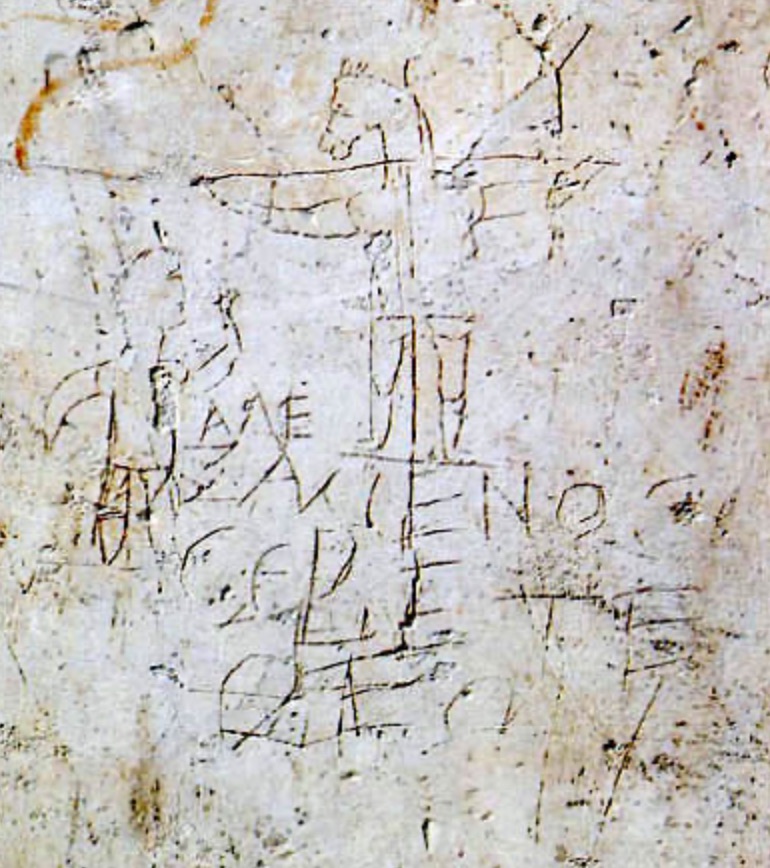

Next to the crucified donkey is Alexamenos, and the description below them says:
ALE XAMENOS ϹΕΒΕΤΕ THEON (original crude Greek with phonetic misspelling)
Ἀλεξάμενος σέβεται θεόν (Proper Greek translation)
Alexamenos worships his god (English translation)
A mocking commentary of the image. Yet, the beauty of this imagery is in what was written in the next chamber of the room. This is added to the stone trace image above to the right, in different handwriting:
ΑΛΕΞΑΜΕΝΟϹ FIDELIS
Alexamenos is faithful
A simple retort to an insult written in stone. So, why is this important? It’s true that we know nothing more about Alexamenos, he was not a character in the Bible, we don’t know who the original author of the graffiti was, and this discovery is not some magical “evidence” that will prove Jesus’ existence to the world. So, what is it then? It is a simple and solemn confirmation of Jesus’ promise:
Blessed are you when people insult you, persecute you and falsely say all kinds of evil against you because of me. Rejoice and be glad, because great is your reward in heaven, for in the same way they persecuted the prophets who were before you. – Matthew 5:11-12
We don’t know much about Alexamenos, but we know that Onolatry was an insult, and we know that whoever he was, he was called faithful. We don’t even know if Alexamenos was actually faithful or not, if he wrote the retort himself to protect his reputation, or if he was even a Christian3, but God remains through the test of time. No matter who Alexamenos was, the truth of scripture remains:
Live such good lives among the pagans that, thought they accuse you of doing wrong, they may see your good deeds and glorify God on the day he visits us. – 1 Peter 2:12
Instead of an insult, the graffiti is an opportunity to bear witness:
But before all this they will lay their hands on you and persecute you, delivering you up to the synagogues and prisons, and you will be brought before kings and governors for my name’s sake. This will be your opportunity to bear witness. – Luke 21:12-13
Persecution is one of the most powerful confirmations of our personal faith. It can be argued that if Alexamenos had not made it evident enough that he was faithful to Jesus, there would have been no insult needed. And the retort given on the second chamber wall is so effective, and not a great defense with a counter-insult or anything, but a simple and calm statement.
One who is faithful in a very little is also faithful in much, and one who is dishonest in a very little is also dishonest in much. – Luke 16:10
But this is not true of my servant Moses; he is faithful in all my house. – Numbers 12:7
At this, the administrators and the satraps tried to find grounds for charges against Daniel in his conduct of government affairs, but they were unable to do so. They could find no corruption in him, because he was faithful and no error or fault was found in him. – Daniel 6:4
I know where you live—where Satan has his throne. Yet you remain true to my name. You did not renounce your faith in me, not even in the days of Antipas, my faithful witness, who was put to death in your city—where Satan lives. – Revelations 2:13
For the sake of Christ, then, I am content with weaknesses, insults, hardships, persecutions, and calamities. For when I am weak, then I am strong. – 2 Corinthians 12:10
This short story about Alexamenos is a simple message and a reminder of the value of faith. Persecution, while painful, is confirmation of our faith and our salvation from God. And God will bless us in this persecution. I wanted to end this post with my own experience seeing ancient graffiti in Rome, and finally a prayer from Psalm, as encouragement during our persecution, and thanksgiving of Christ’s love for us.
Graffiti at the Colosseum

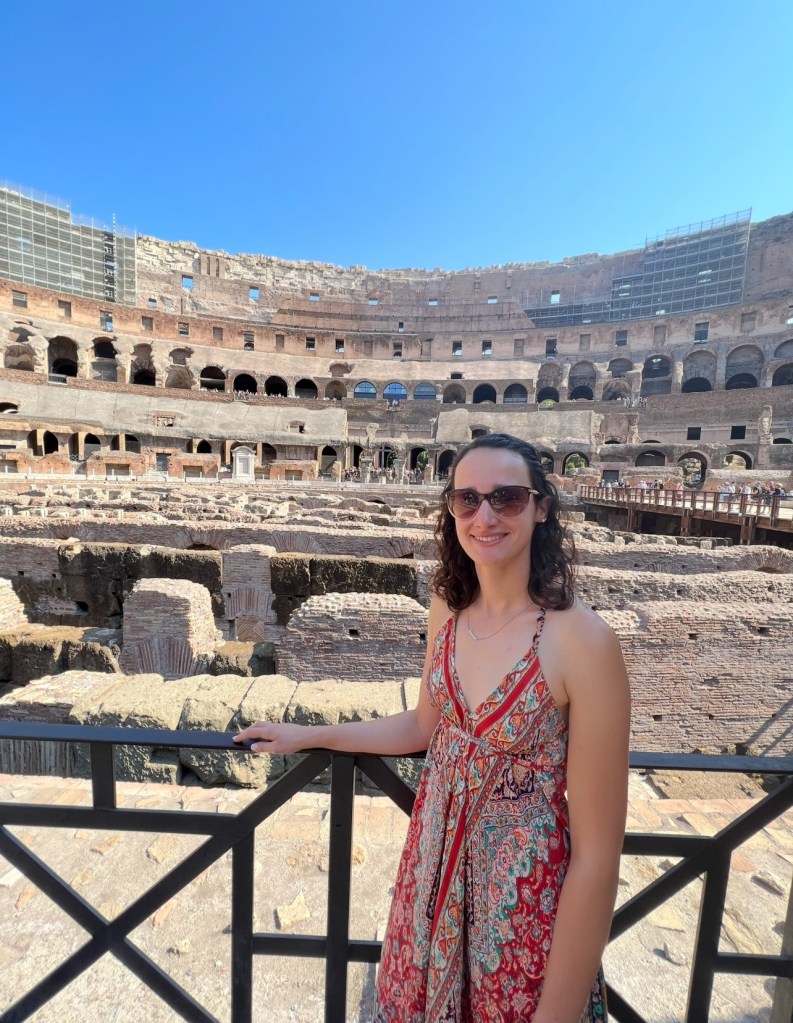
If you ever visit the Colosseum in Rome, I recommend looking out for something that’s very easy to miss. Thousands of Christians were persecuted and killed in the Colosseum by the Roman Empire. But the Roman attempt to destroy the message of Christ lies in ruins, and a simple yet powerful image remains. I took this picture during one of my visits, it’s located at the top of one of the archways you can walk under in the Colosseum.


Take this image however you like, some may say that it’s simply depicting the common crucifixion practice and means nothing else. But I believe that no matter what, it’s a reminder to Christians walking beneath it today of Christ’s sacrifice, the persecution of martyrs, and the evidence of our personal salvation.
Alexamenos is faithful.
Rulers persecute me without cause,
but my heart trembles at your word.
I rejoice in your promise
like one who finds great spoil.
I hate and detest falsehood
but I love your law.
Seven times a day I praise you
for your righteous laws.
Great peace have those who love your law,
and nothing can make them stumble.
I wait for your salvation, Lord,
and I follow your commands.
I obey your statutes,
for I love them greatly.
I obey your precepts and your statutes,
for all my ways are known to you. – Psalm 119:161-168
Footnotes
- Hassett, M. (1907). “The Ass (in Caricature of Christian Beliefs and Practices)”. The Catholic Encyclopedia. Robert Appleton Company. ↩︎
- Everett Ferguson, Backgrounds of Early Christianity (Grand Rapids: Eerdmans, 1987, 2d ed. 1993), 475-76, 2d ed. = 559-61 ↩︎
- Graydon F. Snyder, Ante Pacem: Archaeological Evidence of Church Life Before Constantine (Mercer Univ. Press, 1985), 27-28 ↩︎
 Dave Aldon